Solution Overview
Purpose
Explain the overall solution to a new developer before they read detailed designs.
Example
Show a worked example of this artifact
---
ddx:
id: helix.solution-overview
type: solution-overview
authoring:
home: repo
---
# HELIX solution overview
## Purpose and audience
HELIX gives software teams and their agents a shared set of documents and
rules for keeping product intent, designs, tests, and implementation aligned.
Start here to understand the system; use the [developer guide](https://github.com/DocumentDrivenDX/helix/blob/main/docs/guide/developer/developer-guide.md)
to make a change. This is an explanatory view of the current repository.
[Architecture](https://github.com/DocumentDrivenDX/helix/blob/main/docs/helix/02-design/architecture.md) governs system structure; the
[product requirements](https://github.com/DocumentDrivenDX/helix/blob/main/docs/helix/01-frame/prd.md) govern product scope.
## System map
The self-hosted HELIX pilot includes a presentation rendering with the same
entities and arrow directions as this semantic view:
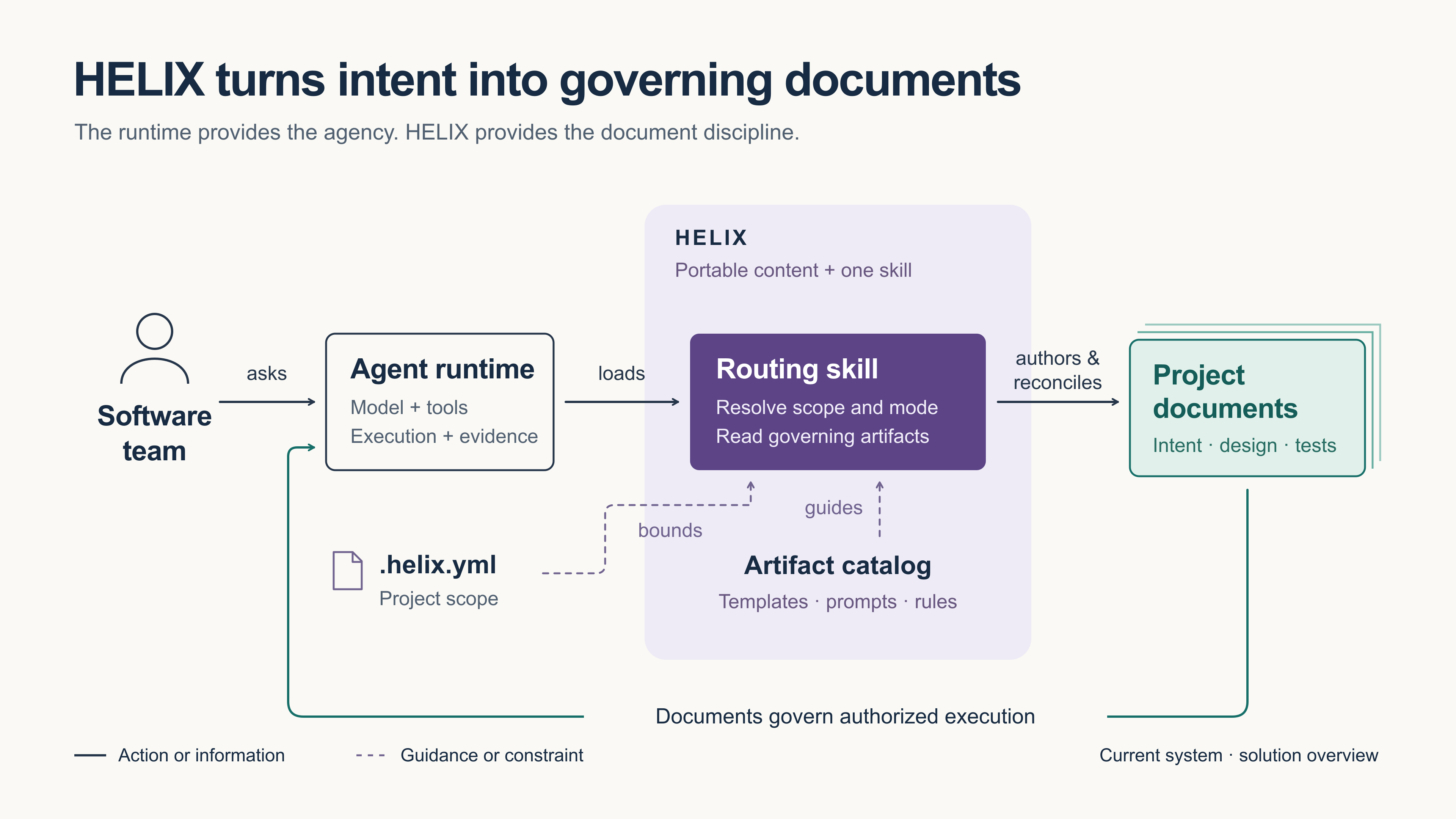
[Editable SVG](https://github.com/DocumentDrivenDX/helix/blob/main/docs/helix/02-design/diagrams/solution-overview.svg) ·
[Design and visual review](https://github.com/DocumentDrivenDX/helix/blob/main/docs/helix/02-design/diagrams/solution-overview-design.md)
The shaded region identifies HELIX-owned content. Dashed arrows show guidance
or constraints; solid arrows show actions or information. The catalog summarizes
templates, prompts, metadata, and mode contracts. Repository paths and omitted
packaging/validation mechanics remain in the adjacent reference material.
Question: how does a team's request become a project document?
Arrows describe information or actions; boxes are content or actors, not running services.
```mermaid
flowchart LR
Team[Software team] -->|asks through| Runtime[Agent runtime]
Runtime -->|loads| Skill[HELIX routing skill]
Marker[Project .helix.yml] -->|bounds scope for| Skill
Catalog[Templates, prompts, metadata, mode contracts] -->|guides| Skill
Skill -->|authors and reconciles| Docs[Project artifact instances]
Docs -->|govern authorized execution by| Runtime
```
The runtime provides model access, file operations, execution, and source
control. HELIX supplies portable Markdown and YAML content plus one routing
skill. A request to plan does not authorize implementation.
## Parts and boundaries
| Part | Responsibility | Where to inspect |
|---|---|---|
| Routing skill | Resolve project scope, catalog, and workflow mode | `skills/helix/SKILL.md` |
| Methodology | Authority order, authoring rules, mode behavior | `workflows/modes/`, `workflows/artifact-schema.md` |
| Artifact catalog | Define each document type through template, prompt, metadata, example | `workflows/activities/*/artifacts/` |
| Type graph | Describe catalog relationships; generated from metadata | `workflows/graph.yml`, `scripts/generate_graph.py` |
| Project documents | Apply HELIX to HELIX itself | `docs/helix/` |
| Delivery tooling | Validate, package, and publish source content | `tests/`, `scripts/`, `docs/website/`, `website/` |
The project marker declares active document roots. Catalog definitions under
`workflows/` are maintained by contributors; ordinary adopting-project authoring
writes instances under the marker's root. Runtime integration is governed by
[CONTRACT-003](https://github.com/DocumentDrivenDX/helix/blob/main/docs/helix/02-design/contracts/CONTRACT-003-ddx-adapter-boundary.md).
## Critical flows
- **Author a document:** resolve marker and catalog, choose a mode, read governing
artifacts and type instructions, write within scope, validate, review.
Follow the [end-to-end walkthrough](https://github.com/DocumentDrivenDX/helix/blob/main/docs/helix/02-design/architecture-walkthrough.md).
- **Change the methodology:** edit canonical content, regenerate derived graph
and reference pages as applicable, run repository gates, review the diff.
Follow the developer guide's change recipes.
- **Deliver to a runtime:** package the same skill and catalog with generated
references. `tests/validate-plugin-package.sh` checks source/package agreement.
Installation instructions live in [docs/install](https://github.com/DocumentDrivenDX/helix/blob/main/docs/install/README.md).
## Vocabulary and reading path
An **artifact type** is a reusable document definition; an **instance** is a
project's document made from it. A **flow** applies a methodology to a marker's
bounded root. A **mode** is a workflow inside the single public `helix` skill.
A **concern** supplies cross-cutting practices such as module boundaries.
Read this overview → architecture walkthrough → developer guide for a first
contribution. Consult Architecture for structural decisions, the catalog for
document contracts, and [installation guidance](https://github.com/DocumentDrivenDX/helix/blob/main/docs/install/README.md) for host setup.
## Maintenance
Contributors update this map when routing, packaging, catalog ownership, or
artifact boundaries change. Review it alongside Architecture. Check every
linked path and trace the critical flow after such changes; generated graph
and reference pages remain derived outputs. This pilot has repository evidence,
but has not yet been tested by an unfamiliar developer.Reference
| Activity | Design — Decide how to build it. Capture trade-offs, contracts, and architecture decisions. |
|---|---|
| Default location | docs/helix/02-design/solution-overview.md |
| Requires | None |
| Enables | None |
| Generation prompt | Show the full generation prompt |
| Template | Show the template structure |
Innsigle seal: model-primary by HELIX
The signature covers the markdown source of this page, not these HTML bytes. This page quotes that seal; verify it against the source file.
- Composition
- model-primary
- Issuer
- HELIX
helix - Signing key
ed25519:b0865d76d834a52c48506414d16f4e5a(build key)- Signed source
artifact-types/design/solution-overview.md- Signed
- 2026-10-22T18:09:54Z
- Content digest
sha256:1c6a8d3f…8e4d1072
This build key is endorsed by the human key for build signing; the signature is not a detector and not a truth guarantee.
Raw attestation JSON
{
  "payload": {
    "innsigle": "1",
    "type": "https://innsigle.dev/claim/colophon/v1",
    "issued_at": "2026-10-22T18:09:54Z",
    "issuer": {
      "id": "helix",
      "name": "HELIX",
      "key_id": "ed25519:b0865d76d834a52c48506414d16f4e5a",
      "key_url": "https://documentdrivendx.github.io/helix/.well-known/innsigle/keys.json"
    },
    "subjects": [
      {
        "uri": "https://documentdrivendx.github.io/helix/artifact-types/design/solution-overview/",
        "digest": {
          "alg": "sha256",
          "value": "1c6a8d3ff4586ef5af920a5d251ee341f21c73becfbd165e0bea92578e4d1072"
        }
      }
    ],
    "colophon": {
      "schema_version": "1",
      "composition": "model-primary",
      "ingredients": [
        {
          "kind": "model",
          "name": "Claude",
          "role": "draft"
        },
        {
          "kind": "tool",
          "name": "sloptimizer",
          "role": "rewrite"
        },
        {
          "kind": "human",
          "name": "operator",
          "role": "structure-edit"
        }
      ],
      "notes": null
    }
  },
  "payload_encoding": "json",
  "signatures": [
    {
      "key_id": "ed25519:b0865d76d834a52c48506414d16f4e5a",
      "alg": "ed25519",
      "sig": "RZ97a0YGK6mg4j3VT0tCE-2tlykekG7SxHDecBp802924JCf90fNB71lfo62Es2y5tkl2N6gIhmTPxm-YnoICw",
      "signed_at": "2026-10-22T18:09:54Z"
    }
  ]
}